
Buffet Restaurants — Travelling Asia wearing a bulletproof vest
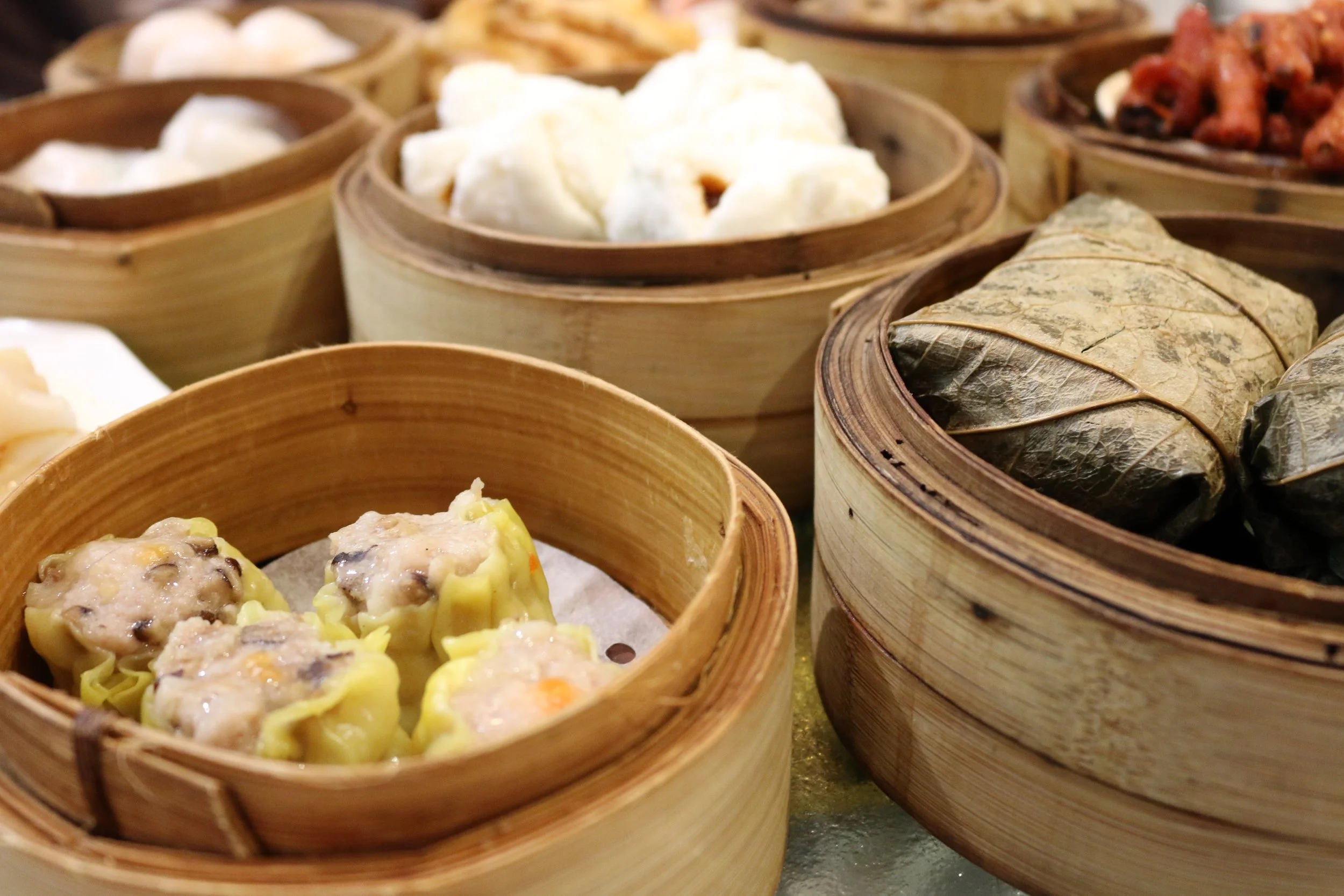
The scent of fried food lingers in the air. Nearby speakers play a high-pitched singer who seems to lament unbearable distress. Countless people shove and push each other through narrow alleys as they load piles of shrimp, beef, and sushi onto small plates. Buffet restaurants are booming, and they are a true paradise for penny pinchers who get to enjoy a culinary voyage through Asia for the price of a meal. Daily, these gourmet temples welcome dozens of hungry mouths while trying to do every bit of Southeast Asian imagery justice. They are the foreign in the homeland, the exoticism in the familiar, and the short vacation away from the stressful daily life. But the line between trancelike overfeeding and appropriate representation of Asian food culture seems blurred. What are they representing anyways? A collection of Asian tastes or an expedition into Chinese food culture? The answer seems as clear as the meaning behind what my old childhood friend meant when he said he imagined China to be a beautiful city. We briefly stumbled upon each other and never again after that.
Asia, the continent
The terms Asian or Chinese, often referred to as the Asian or the Chinese, seem to have become hollowed-out collectives. They signify crowded tourist busses near the Eiffel tower, noodle boxes for 2,50€, or a ruthless and oppressive scoring system. Vastly different cultures are thrown into a bag and given a good shake “because I am not a racist, but they all somehow look the same.“ Out of that emerges a stereotypical prototype for everyday use.
One should realize that Asian and Chinese are not interchangeable adjectives. China is a country in Asia, the continent. That continent is unbelievably huge and consists of an abundance of different countries. Asia is as much Chinese as it is Japanese, Korean, Indonesian, Vietnamese, Indian, Uzbek, Pakistani, Cambodian, Sri Lankan, Nepali, Iraqi, Turkmen, Lebanese and more. All these countries not only differ climatically but are also extremely diverse culturally. The inhabiting civilizations often date back thousands of years and are considerably older than any culture in Europe. They all speak different languages, celebrate diverse traditions, and boast regionally distinctive cuisines. Our knowledge of these cultures is often still limited and rooted in prejudice. There is totalitarian China, which abducts and kills thousands of people daily. Or North Korea, a dictatorship with a maniacal leader who fantasizes about nuclear warheads day in and day out. Or Thailand, with its magical beaches, on which sex-obsessed Europeans act out their fetishes and desires with delicate women, “given that they are female. In Thailand, you can never be 100% certain that they will not surprise you with a penis.”
China, the country
The eastern part of the Asian continent is the home of the People's Republic of China, a country, famous for its totalitarian traits so meticulously mapped out by Western media. You hear of imprisoned intellectuals or a ruthless scoring system evaluating citizens based on their deference to authority. We consume those stories without filter, thus constructing an imaginative Chinese society inhabited by deindividualized silhouettes. Empty vessels that robotically work themselves to death in factories or salute for their lives during military drills. Helplessness and claustrophobia paint our picture of China. It is certainly true that China's political and social situation differs from democratic ideals, but the firm prejudice and half-truths with which we underpin these assumptions are appalling. Similarly, the general public adheres to rhetorical beliefs that reveal themselves as nothing more than superficial knowledge at best.
“They are always so friendly, but that is not surprising if you consider that obedience runs through their veins.”
“Day in, day out, they scurry around like ants trying to make a penny. It's so inspiring to see they are still smiling.”
“I know that Asians are somewhat Buddhist. But they still visit Sunday mass like good Christians do, right?”
By default, we assume that the Chinese population is incapable of critical thinking or formulating an assessment of their living conditions. These assumptions then reflect onto the whole of Asia.Insinuating weakness and subservience makes Chinese society the antagonist of Western individuals, who value freedom and self-expression above all else. It goes as far as denying Asians any sexual self-determination. Something that is especially prevalent in fantasies of Thai jungles, where sex-crazed ladyboys and delicate women wait to be dominated by white travelers.In the event of any cultural involvement, we display the tendency to get our teeth into the lowest common denominator with western culture. The lines between fact and fiction are heavily blurred, and any truth is abstracted, distorted, and changed beyond recognition. The small talk about Asian food culture, for example, has been dominated by the intake of dog meat for years. Another example would be the persistent rumor of a remote mountainous region in the middle of China, where villagers keep up the tradition of cooking soup from human baby fetuses. Any feature that differs from countries of the Western world is characterized by an archaic undertone, a barbaric brutality, erupting during ritualized eating habits, distinguishing us from them. Some may have already been pushed to their limits, angrily referring to a video “of a monkey-brain eating Vietnamese, Chinese, or whatever he was.” Those should keep in mind that cultural dialogue does not serve the purpose of defending a culture's every practice. Or is there anyone defending fast-food-induced obesity as a merit of Western excellence because“ it simply tastes too good?” It is about understanding that a country is more than what we comprehend about its culture. It is more than its political discourse. It is more than the difference between me and that one over there.
One metaphor to rule them all
Buffet restaurants metaphorically depict our ignorant approach to cultural dialogue. Their decoration is an exaggerated amalgamation of symbols our minds perceive as somewhat Asian. A koi pond ripples, plastic columns imitate a pagoda, and every corner is filled with Buddha, smiling at you. Red ornaments and Chinese characters sashay along the walls directing your sight toward a watercolor painting of The Great Wall of China. “The Chinese outdid themselves there.” This bootleg opulence irritates the stern-faced customers pushing their tolerance to their limits as Chinese classical music plays in the background. Binge eating seems to be the only way out of that misery. A counter filled with sushi fuses Japanese tradition with cream cheese and arugula. A landscape of deep-fried shapes invites you to ponder their insides close by. An array of pre-cooked food, whose names evoke the spirits of traditional Chinese dishes, awaits our attention. Considering the name tags are in the right place, that is. Their authenticity is as questionable as a racist's claim to be speaking the truth. The Mongol barbecue completes the culinary bouquet inviting you to create a dish out of a vast choice of raw ingredients, then barbecued with a sauce of your creation. Within this abundance of food lies a hidden core of rules to be observed under any circumstance. Any violation would endanger the customers' fragile sense of home within the Chinese foreign. Like a high-diver needs a springboard, a Westerner needs french fries and potato gratin to dive into the ocean of Asian food culture. And this is despite that most dishes are already adjusted to Western taste buds, using Ketchup as a base for almost all sauces. In addition to that, the excessive level of meat consumption seems to emanate more from a western desire than from a Chinese reality. Now a symbol of an aspiring middle-class, meat and seafood in such abundance had long been an economic impossibility for most. All in all, Chinese cuisine looks back at cultural traditions that span several centuries and utilizes the vast amount of ingredients and spices available in the country. However, there are not many traces of them in the golden halls of buffet restaurants.
Tell me about China!
An inherent inhibition to embrace the unknown seems natural because evaluating unknown stimuli and possible dangers increases our chances of survival. However, approaching foreign cultures in such a way is questionable and fear-driven. It exhibits miseducation by parental generations rather than a healthy instinct. We become especially sensitive to such fearmongering when the media transforms the Other into a boogeyman that supposedly threatens the stability of our private ecosystem.
As the opposite pole to the American way of life, which dominates our consumer culture, China demonstrates this fact like no other. The media regularly confronts us with political realities and speculative facts about its very own Lord Voldemort. As a result, the only way we can perceive China is in political relation, meaning in the intensity that it differs from what we consider democratic ideals. Consequentially, the human as an individual loses its meaning through its country's politics and government. A condition that only intensifies in times of anxiety about eroding democracies and waning ideals of freedom. In those times, the answer to what is Chinese seems to be polluting snow machines during the Olympic Winter Games, anonymized high-rise buildings, or decomposing lungs within smog and traffic. It parallels our perception of buffet restaurants. It is neither about authenticity nor about the dishes, whose roots trace back to old dynasties or mountain villages cut off from the outside world. It is about cheap food, the lowest common denominator between German and Chinese food cultures. China has it, and we want it. Historically rooted anxiety about food security reduces Chinese cuisine to cost-benefit maximization at the end of the German food chain. In addition to that, we are often overwhelmed by the new and unknown. Many of us are not willing to sacrifice our feeling of fullness for new taste experiences, fearing the possibility of malinvested money.
More than anecdotes!
It's the 21st century, the supposed stronghold of human progress. Allegedly we are doing as well as we never have before. Technological innovations constantly compete to increase our happiness sky high. But old thought patterns are still close at hand. You can feel them breathe down your neck, just like prejudice has not faded adequately for such an advanced society. Cultural insecurities are also still very much part of our lived experience. They should, however, not be treated merely as vehicles to distinguish political reality from fiction, but be considered an incentive to look closer. To expose the othering and recognize the humanity in what some of us grow up to fear and judge. China is not just its totalitarian government, just like India is more than its smelly alleyways. Thailand is not just sex tourism, just like Asia is more than the sum of our prejudices. More than anecdotes about dogmeat and the odor of garlic. More than tortured souls and genocide. It is destiny and happy laughter. Lifelong friendships and walks by the beach. Breathtaking nature and neon cities. The first kiss in a narrow alley and a declaration of love by a cookshop. All these nuances get lost in political finger-pointing, whose sole interest is to place blame where it leaves the territory of western responsibility. It is on us humans to create connections, to find readily available links. Whether it's Asian supermarkets, the Japanese neighbor, or the Indian family owning a restaurant across the street. It is easy to initiate a dialog. For those considering these measures to be too drastic, there is always the opportunity to use modern technology. Instead of drooling over half-naked men on a beach, we could use it for what it was initially created. As a gigantic archive of knowledge constantly available at the tip of our fingers. Of course, involvement in foreign cultures varies with each individual, and sometimes people are just not that interested. But especially under those circumstances, we have to ask ourselves an important question. Is it necessary to imitate the waiter's accent? Is it right to pray humorously that your food delivery may not contain dog meat? Is it appropriate, for the sake of peace and quiet, to laugh about your drunken uncle's bat-joke, he proclaims over dinner? As in many other situations, a lack of knowledge does not protect you from stupidity.